KING SAMON FISHING ON THE KENAI & KASILOF RIVERS
King salmon are Alaska’s most prized sport fish — and for good reason. These fish can push past 50 pounds, hit your line like a freight train, and pull drag in a way that nothing else does. The moment one takes, you’ll understand why anglers travel from around the world just to get a shot at them.
The Kenai River produces some of the largest king salmon on earth. Knowing where they hold, when the runs peak, and what they’ll eat on any given day is the difference between a full boat and a long day of watching your rod tip.
RiverRise Fishing Guides has been running fully guided king salmon trips on the Kenai and Kasilof Rivers for over 25 years. We know these fish. We know these rivers. Let’s get you on the kings.
When And Where We Fish For King Salmon
We fish two distinct runs across both the Kenai and Kasilof Rivers. Understanding the difference helps you book the right trip.
EARLY RUN – JUNE 1ST THROUGH END OF JUNE
We start chasing the Early Run Kasilof King Salmon on June 1st. On the Kasilof, early run fish are primarily hatchery kings — generally harvestable, ranging 8 to 40 pounds, with smaller fish pushing in first and the bigger ones following. This is a great window for anglers who want to take fish home. Lighter crowds, reliable fishing, and a hatchery king in the 20-pound class is still one of the hardest-fighting fish you’ll find in freshwater.
LATE RUN – MID-JUNE THROUGH JULY 31ST
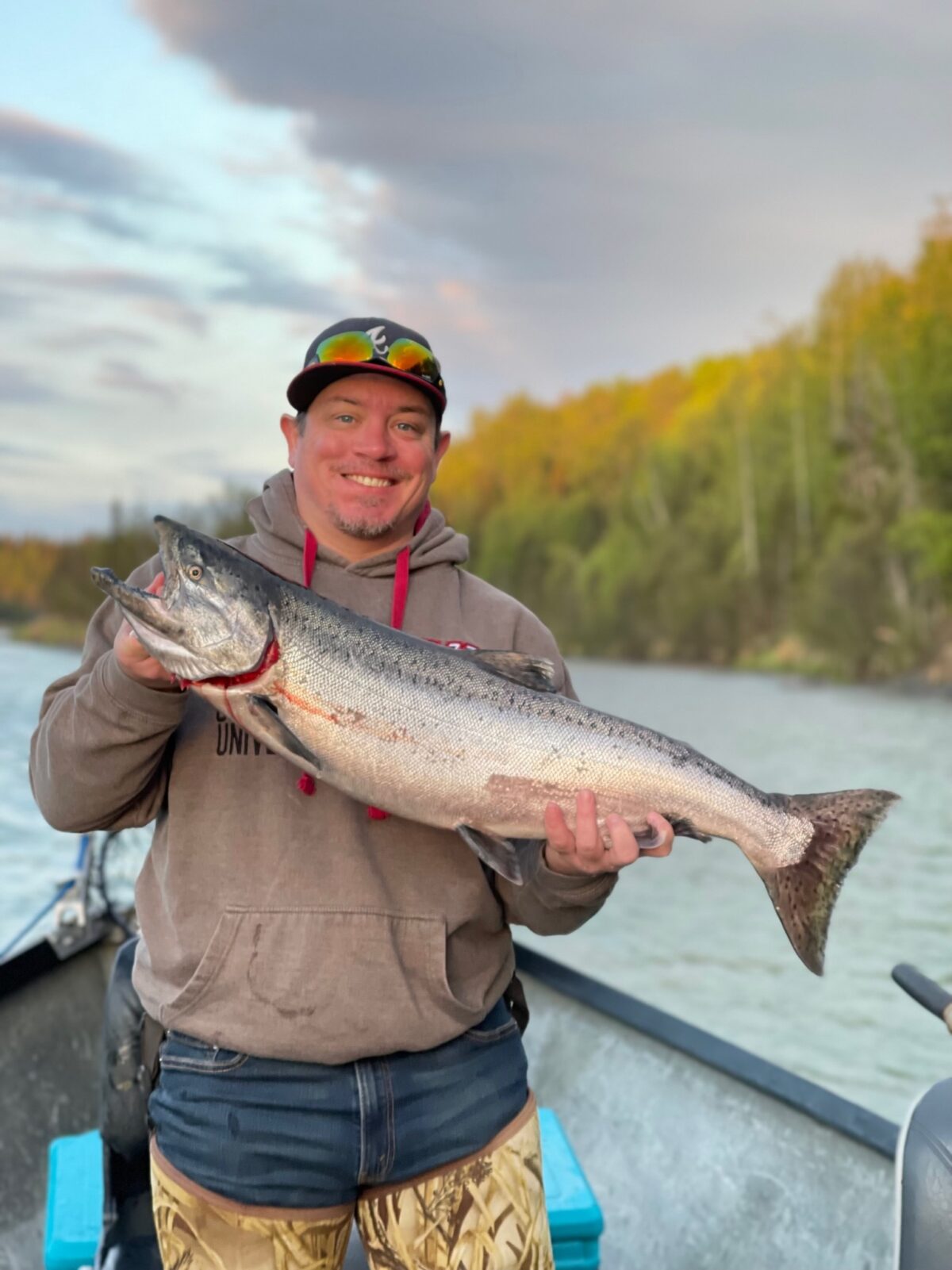
The late run brings the bigger fish — larger adult wild kings that have spent more time in the ocean and come back heavier. On the Kenai, late run fish averaging 20–50+ pounds are common in strong years. These are primarily wild kings, which means catch-and-release in most years. That’s not a reason to skip it. A wild Kenai River king on the end of your line — fought, photographed, and released — is an experience that holds up long after the trip is over. We stay current on all Alaska Department of Fish & Game regulations, which change annually and by river. You’ll never have to guess what’s harvestable on your trip day — we handle that.
PEAK WINDOW
If you want the best of both runs, book late June. That’s when the early run is still producing and the late run fish start pushing in — two shots at kings on the same trip.
⭐⭐⭐⭐⭐ “Nick put us on Kings all morning. My dad landed a 32-pounder – the fish of a lifetime! Best day of our Alaska trip.”
HOW WE FISH FOR KING SALMON
BACK-TROLLING WITH PLUGS
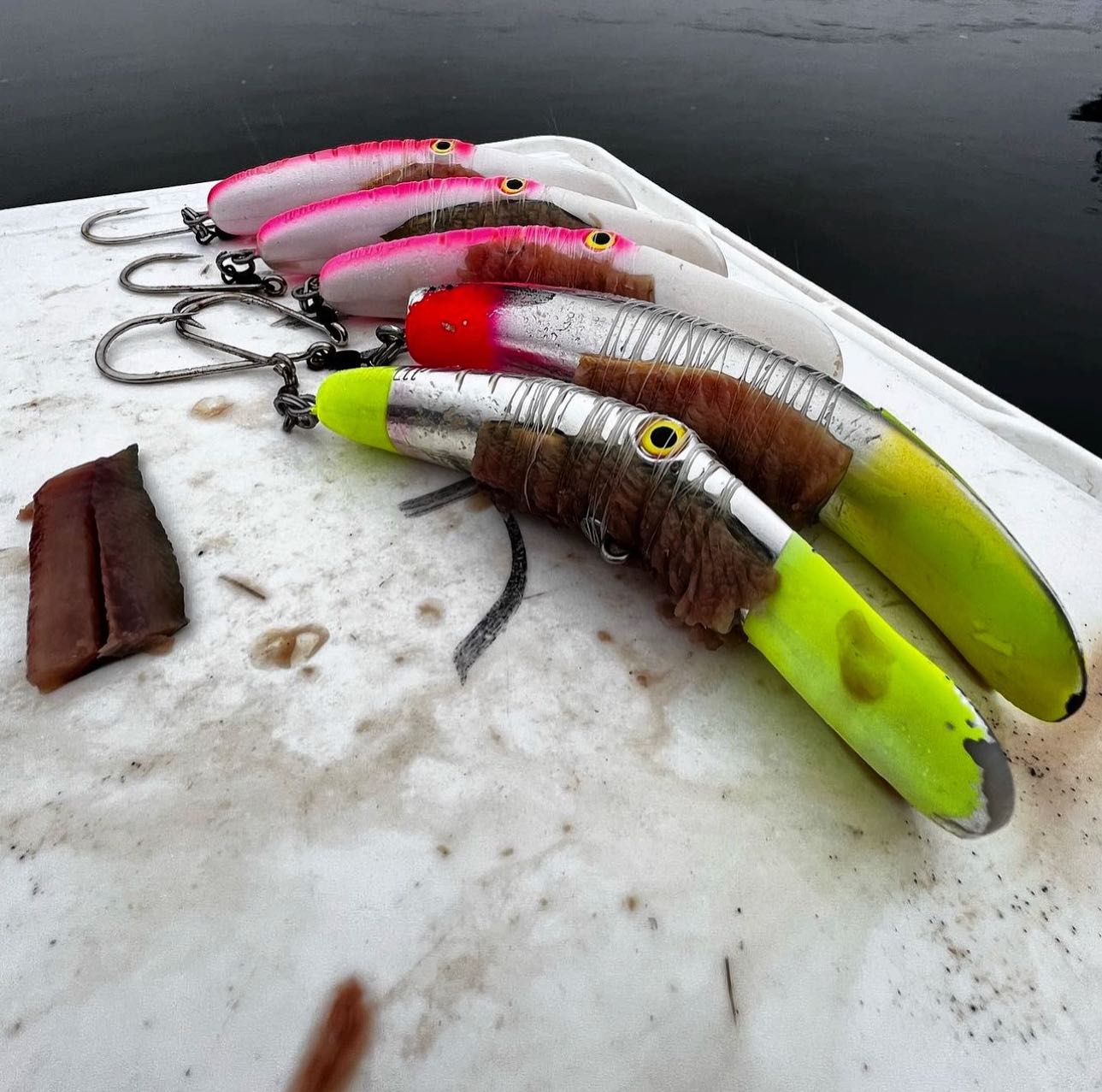
Nearly all of our king salmon fishing is done from the boat using back-trolling. We lower a Kwikfish or MagLip plug to the bottom, set the rod in the holder, and work it through the holding pockets where fish stage. Your guide controls the boat — you watch the rod and wait. When a king loads up, you’ll know immediately.
BACK-BOUNCING WITH CURED EGGS
When conditions call for it, we switch to back-bouncing — a weight and custom-cured salmon eggs worked along the bottom through the holding water. The bait is cured specifically for the river we’re fishing that day. Some sections run hotter, some sweeter. We know the difference. Both methods are effective. We read the conditions and run whatever is working.
The Gear We Use to Catch King Salmon
All rods, reels, tackle, and custom-cured bait are provided. You don’t need to bring anything except your fishing license and king salmon stamp.
Rods — Custom Stryker Fishing Rods built specifically for RiverRise Fishing. Conventional rods are 9-foot diver/plug rods. Spinning rods are 10-foot, 10–20lb float rods.
Reels — Shimano Tekota 400s with line counters for conventional. 13 Fishing AL-13 reels for spinning.
Line — P-Line throughout. 40–60lb braid mainline with 30–40lb fluorocarbon leader.
Baits — Kwikfish and MagLip plugs, or custom-cured salmon eggs prepared specifically for the river and conditions that day.
We run premium gear because king salmon demand it.
READY TO CATCH YOUR KING SALMON?
Our 2027 King Salmon season runs June 1st – July 31, with peak fishing in late June, when both runs overlap.
What’s Included…
2027 Trip Pricing…
Yes. In addition to your Alaska State Fishing License, a King Salmon Stamp is required. Get it sorted before you arrive on the Kenai Peninsula — we’ll remind you before your trip.
Yes. Regulations change annually and by river. Our guides stay current on all ADF&G regulations to ensure legal and ethical fishing.
Kenai and Kasilof kings commonly run 20–50+ pounds. Early run hatchery fish on the Kasilof typically range 8–40 pounds. Late run wild kings on the Kenai push larger — fish in the 30–50 pound class are caught every season in strong return years.
Absolutely. If you’ve never caught a king salmon, that’s fine — most of our clients haven’t. We’ll walk you through every step. The technique isn’t complicated. The fish will do the rest.
Common methods include backtrolling plugs, drift fishing with bait, and casting spinners, all tailored to river flow and fish behavior.
The Kasilof River starts seeing fish in early to mid-June. The Kenai run peaks around the Fourth of July. Both rivers fish well through the end of August. Peak limits are most consistent from the second week of July through the first week of August.